Hydropandas Objects
In the HydroPandas Python package, the Obs and ObsCollection classes are designed to handle time series data related to hydrological observations.
The Obs class represents a single time series of measurements at a specific location, such as groundwater levels or precipitation amounts. It is a subclass of the pandas DataFrame, enriched with additional attributes and methods for the type of observation it holds. There are specialized subclasses of Obs for different measurement types, including:
GroundwaterObs: for groundwater measurements
WaterQualityObs: for (ground)water quality measurements
WaterlvlObs: for surface water level measurements
ModelObs: for observations from a MODFLOW model
MeteoObs: for meteorological observations
PrecipitationObs: for precipitation observations (subclass of MeteoObs)
EvaporationObs: for evaporation observations (subclass of MeteoObs)
The ObsCollection class represents a collection of Obs objects, such as multiple groundwater level time series within a certain area. It is also a subclass of the pandas DataFrame, where each row contains metadata (e.g., coordinates of the observation point) and the corresponding Obs object that holds the measurements. Both Obs and ObsCollection classes include methods for reading data from various sources, facilitating the management and analysis of hydrological time series data.
Notebook contents
[1]:
import numpy as np
import pandas as pd

import hydropandas as hpd

hpd.util.get_color_logger("INFO")
[1]:
<RootLogger root (INFO)>
Obs
Creating an Obs object is very similar to creating a DataFrame. Below we create 3 differente Obs objects:
an empty Obs
an Obs with only metadata
an Obs with metadata and measurements
[2]:
# 1. create an empty Obs object
o1 = hpd.Obs(name="my empty obs")
display(o1)
hydropandas.Obs
| my empty obs | |
|---|---|
| x | NaN |
| y | NaN |
| location | |
| filename | |
| source | |
| unit |
[3]:
# 2. create an Obs object with only metadata
o2 = hpd.Obs(
    name="my_observation",
    x=10,
    y=20,
    location="somewhere",
    filename="unknown",
    source="imagination",
    unit="m",
)
display(o2)
hydropandas.Obs
| my_observation | |
|---|---|
| x | 10 |
| y | 20 |
| location | somewhere |
| filename | unknown |
| source | imagination |
| unit | m |
[4]:
# 3. create an Obs object with both metadata and measurements
meas_df = pd.DataFrame(
    index=pd.date_range(start="2020-01-01", periods=10, freq="D"),
    data={"value": np.random.rand(10)},
)
o3 = hpd.Obs(
    meas_df,
    name="smw",
    x=1000,
    y=22220,
    location="somewhere else",
    source="advanced imagination",
    unit="m",
)
display(o3)
hydropandas.Obs
| smw | |
|---|---|
| x | 1000 |
| y | 22220 |
| location | somewhere else |
| filename | |
| source | advanced imagination |
| unit | m |
| value | |
|---|---|
| 2020-01-01 | 0.615775 |
| 2020-01-02 | 0.089501 |
| 2020-01-03 | 0.239719 |
| 2020-01-04 | 0.234791 |
| 2020-01-05 | 0.070248 |
| 2020-01-06 | 0.189405 |
| 2020-01-07 | 0.518016 |
| 2020-01-08 | 0.809684 |
| 2020-01-09 | 0.701961 |
| 2020-01-10 | 0.616406 |
Metadata
Access observation metadata as attributes.
[5]:
print(f"x coordinate of observation 1: {o1.x}")
print(f"x coordinate of observation 2: {o2.x}")
print(f"x coordinate of observation 3: {o3.x}")
x coordinate of observation 1: nan
x coordinate of observation 2: 10
x coordinate of observation 3: 1000
[6]:
print(f"source of observation 1 is : {o1.source}")
print(f"location of observation 2 is : {o2.location}")
print(f"name of observation 3 is : {o3.name}")
source of observation 1 is :
location of observation 2 is : somewhere
name of observation 3 is : smw
Measurements
Access observation measurements as if the observation is a DataFrame with the measurements.
[7]:
display(o3["value"]) # show measurements
2020-01-01    0.615775
2020-01-02    0.089501
2020-01-03    0.239719
2020-01-04    0.234791
2020-01-05    0.070248
2020-01-06    0.189405
2020-01-07    0.518016
2020-01-08    0.809684
2020-01-09    0.701961
2020-01-10    0.616406
Freq: D, Name: value, dtype: float64
[8]:
perc85 = o3["value"].quantile(0.85)  # get percentile
print(f"the 85th percentile of my measurements is {perc85:.2f} {o3.unit}")
the 85th percentile of my measurements is 0.67 m
[9]:
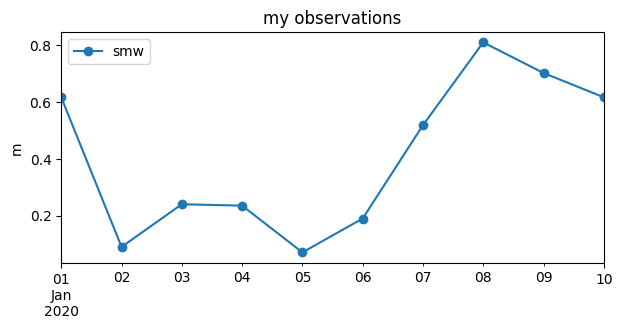
o3["value"].plot(
    figsize=(7, 3),
    label=o3.name,
    ylabel=o3.unit,
    marker="o",
    legend=True,
    title="my observations",
);  # plot measurements
Obs types
Different Obs types have differente metadata. Groundwater observations have some extra properties screen_top, screen_bottom, ground_level, tube_top and metadata_available.
[10]:
gw_obs = hpd.GroundwaterObs(
    o3,
    name="smw_pb1",
    tube_nr=1,
    screen_top=-5,
    screen_bottom=-6,
    unit="m NAP",
    ground_level=3,
    tube_top=2.95,
    metadata_available=True,
)  # create a GroundwaterObs object from the Obs object
display(gw_obs)
hydropandas.GroundwaterObs
| smw_pb1 | |
|---|---|
| x | 1000 |
| y | 22220 |
| location | somewhere else |
| filename | |
| source | advanced imagination |
| unit | m NAP |
| tube_nr | 1 |
| screen_top | -5 |
| screen_bottom | -6 |
| ground_level | 3 |
| tube_top | 2.95 |
| metadata_available | True |
| value | |
|---|---|
| 2020-01-01 | 0.615775 |
| 2020-01-02 | 0.089501 |
| 2020-01-03 | 0.239719 |
| 2020-01-04 | 0.234791 |
| 2020-01-05 | 0.070248 |
| 2020-01-06 | 0.189405 |
| 2020-01-07 | 0.518016 |
| 2020-01-08 | 0.809684 |
| 2020-01-09 | 0.701961 |
| 2020-01-10 | 0.616406 |
Modify
Sometimes you want to change measurement values or metadata of an Obs object.
[11]:
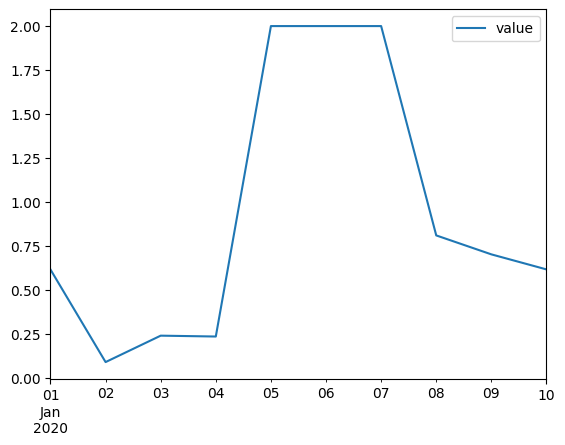
# modify measurements (similar to how you modify a pandas DataFrame)
o3.loc["2020-01-05":"2020-01-7", "value"] = 2  # set value of a specific date
o3.plot()
[11]:
<Axes: >
[12]:
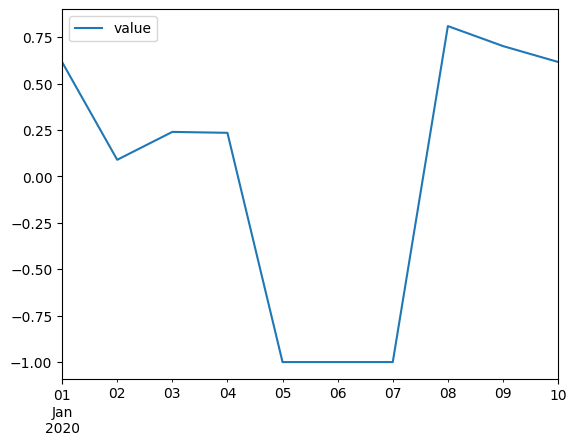
# create new Obs object from existing
o4 = o3.copy()  # note use the copy method to create a new object
o4.loc["2020-01-05":"2020-01-7", "value"] = -1
o4.plot()
[12]:
<Axes: >
[13]:
# modify metadata by direct assignment
o4.name = "smw_modified"
o4.source = "smw"
display(o4)
hydropandas.Obs
| smw_modified | |
|---|---|
| x | 1000 |
| y | 22220 |
| location | somewhere else |
| filename | |
| source | smw |
| unit | m |
| value | |
|---|---|
| 2020-01-01 | 0.615775 |
| 2020-01-02 | 0.089501 |
| 2020-01-03 | 0.239719 |
| 2020-01-04 | 0.234791 |
| 2020-01-05 | -1.000000 |
| 2020-01-06 | -1.000000 |
| 2020-01-07 | -1.000000 |
| 2020-01-08 | 0.809684 |
| 2020-01-09 | 0.701961 |
| 2020-01-10 | 0.616406 |
Additional metadata
You can have metadata that does not match any of the default metadata names for a particular Observation type. For groundwater observations you may for example have the name of the company that constructed the measurement well. This additional metadata can be stored in the meta attribute as a dictionary. Below we create a GroundwaterObs object with some additional metadata.
Note that display(gw_obs) will never display the meta dictionary.
[14]:
gw_obs = hpd.GroundwaterObs(
    o3,
    name="smw_pb1",
    tube_nr=1,
    screen_top=-5,
    screen_bottom=-6,
    unit="m NAP",
    ground_level=3,
    tube_top=2.95,
    metadata_available=True,
    meta={"contractor": "GeoDrill Inc."},
)
print(gw_obs.meta)
{'contractor': 'GeoDrill Inc.'}
Read/write Obs
Observations can be read/written from/to a json, csv, excel or pickle file, see this table:
type |
write function |
read function |
Human readable |
Store metadata |
Write/read additional metadata* |
keep dtypes? |
|---|---|---|---|---|---|---|
json |
Obs.to_json |
hpd.read_json |
Yes |
Yes |
Yes |
Mostly |
csv |
Obs.to_csv |
Obs.from_csv |
Yes |
Yes |
No |
No |
pickle |
Obs.to_pickle |
Obs.from_pickle |
No |
Yes |
Yes |
Yes |
excel* |
Obs.to_excel |
pd.read_excel |
Yes (in Excel) |
No |
No |
No |
*the to_excel method is the inherited method from a pandas DataFrame. The other methods are methods adapted for hydropandas.
json
Json is a human readable format that can be used to store observation objects. Additional metadata is kept in the json file and it is more robust for keeping the same dtypes. At times small details, such as the index frequency, may be different between the original file and the one that is written and read to a json file.
[15]:
# write to json
gw_obs.to_json("my_gw_obs.json", indent=4)
gw_obs
[15]:
hydropandas.GroundwaterObs
| smw_pb1 | |
|---|---|
| x | 1000 |
| y | 22220 |
| location | somewhere else |
| filename | |
| source | advanced imagination |
| unit | m NAP |
| tube_nr | 1 |
| screen_top | -5 |
| screen_bottom | -6 |
| ground_level | 3 |
| tube_top | 2.95 |
| metadata_available | True |
| value | |
|---|---|
| 2020-01-01 | 0.615775 |
| 2020-01-02 | 0.089501 |
| 2020-01-03 | 0.239719 |
| 2020-01-04 | 0.234791 |
| 2020-01-05 | 2.000000 |
| 2020-01-06 | 2.000000 |
| 2020-01-07 | 2.000000 |
| 2020-01-08 | 0.809684 |
| 2020-01-09 | 0.701961 |
| 2020-01-10 | 0.616406 |
[16]:
# read from json
gw_obs_from_json = hpd.read_json("my_gw_obs.json")
gw_obs_from_json
[16]:
hydropandas.GroundwaterObs
| smw_pb1 | |
|---|---|
| x | 1000 |
| y | 22220 |
| location | somewhere else |
| filename | |
| source | advanced imagination |
| unit | m NAP |
| tube_nr | 1 |
| screen_top | -5 |
| screen_bottom | -6 |
| ground_level | 3 |
| tube_top | 2.95 |
| metadata_available | True |
| value | |
|---|---|
| 2020-01-01 | 0.615775 |
| 2020-01-02 | 0.089501 |
| 2020-01-03 | 0.239719 |
| 2020-01-04 | 0.234791 |
| 2020-01-05 | 2.000000 |
| 2020-01-06 | 2.000000 |
| 2020-01-07 | 2.000000 |
| 2020-01-08 | 0.809684 |
| 2020-01-09 | 0.701961 |
| 2020-01-10 | 0.616406 |
[17]:
print("index frequency original:", gw_obs.index.freq)
print("index frequency from json:", gw_obs_from_json.index.freq)
index frequency original: <Day>
index frequency from json: None
csv
When Obs object are written and read from a csv file: 1. The datatypes may have changed 2. The additional metadata in the .meta attribute is lost.
[18]:
# save the groundwater observations to a csv file
gw_obs.to_csv("my_gw_obs.csv")
WARNING:hydropandas.observation.to_csv:additional metadata of observation smw_pb1 not written to csv, consider using the to_json method to keep the metadata
[19]:
# read the groundwater observations from a csv file
gw_obs_from_csv = hpd.GroundwaterObs.from_csv("my_gw_obs.csv")
[20]:
# 1. datatypes changed
print("datatype of gw_obs.screen_top:", type(gw_obs.screen_top))
print("datatype of gw_obs_from_csv.screen_top:", type(gw_obs_from_csv.screen_top))

# 2. additional metadata is not saved in the csv file
print(f"\nadditional metadata: {gw_obs.meta=}")
print(f"additional metadata: {gw_obs_from_csv.meta=}")
datatype of gw_obs.screen_top: <class 'int'>
datatype of gw_obs_from_csv.screen_top: <class 'float'>

additional metadata: gw_obs.meta={'contractor': 'GeoDrill Inc.'}
additional metadata: gw_obs_from_csv.meta={}
pickle
Pickle files are binary and not readable for humans. They are very fast to write/read and return an exact copy of the original file. Pickle files are not very useful for long-term storage because they:
are only readable in Python
are not stable across Python and package versions.
contain references to exact class and module paths
[21]:
# save the object to a pickle file
gw_obs.to_pickle("my_gw_obs.pklz")
[22]:
# read the object from a pickle file
gw_obs2 = hpd.read_pickle("my_gw_obs.pklz")
[23]:
gw_obs2.equals(gw_obs) # check if the two objects are equal
[23]:
True
ObsCollection
An ObsCollection is a structured way to manage and analyse multiple time series of hydrological observations. It serves as a container for multiple Obs objects, which represent individual time series of measurements, such as groundwater levels, precipitation, or water quality.
Each row in an ObsCollection contains metadata (e.g., location, station name) and a corresponding Obs object holding the time series data. This structure allows for easy comparison, filtering, and statistical analysis across multiple observation sites.
[24]:
# create an empty ObsCollection
oc = hpd.ObsCollection()
print(oc)
Empty ObsCollection
Columns: []
Index: []
[25]:
# create an ObsCollection with a single Obs object
oc = hpd.ObsCollection(o3)
oc
[25]:
| x | y | location | filename | source | unit | obs | |
|---|---|---|---|---|---|---|---|
| name | |||||||
| smw | 1000 | 22220 | somewhere else | advanced imagination | m | Obs smw -----metadata------ name : smw x : 10... |
[26]:
# create an ObsCollection with multiple Obs objects
oc = hpd.ObsCollection([o1, o2, o3])
oc
[26]:
| x | y | location | filename | source | unit | obs | |
|---|---|---|---|---|---|---|---|
| name | |||||||
| my empty obs | NaN | NaN | Obs my empty obs -----metadata------ name : my... | ||||
| my_observation | 10.0 | 20.0 | somewhere | unknown | imagination | m | Obs my_observation -----metadata------ name : ... |
| smw | 1000.0 | 22220.0 | somewhere else | advanced imagination | m | Obs smw -----metadata------ name : smw x : 10... |
ObsCollection metadata
Access the metadata using the standard DataFrame methods.
[27]:
print(f"the x coordinate of observation 2 is: {oc.loc['my_observation', 'x']}")
print(f"the location of observation 3 is: {oc.loc['smw', 'location']}")
the x coordinate of observation 2 is: 10.0
the location of observation 3 is: somewhere else
ObsCollection observations
Access the Obs objects from the collection
[28]:
# using the loc method
o3_1 = oc.loc["smw", "obs"]

# using the get_obs method with the name of the observation
o3_2 = oc.get_obs("smw")

# using the get_obs method with the location (only works if the location is unique)
o3_3 = oc.get_obs(location="somewhere else")

# check if the three objects are the same
id(o3_1) == id(o3_2) == id(o3_3)
[28]:
True
Slice ObsCollection
Filter and slice ObsCollections
[29]:
oc.loc[oc["y"] > 10] # Selection based on the y coordinate
[29]:
| x | y | location | filename | source | unit | obs | |
|---|---|---|---|---|---|---|---|
| name | |||||||
| my_observation | 10.0 | 20.0 | somewhere | unknown | imagination | m | Obs my_observation -----metadata------ name : ... |
| smw | 1000.0 | 22220.0 | somewhere else | advanced imagination | m | Obs smw -----metadata------ name : smw x : 10... |
[30]:
oc.loc[oc["source"].str.contains("advanced")] # Selection based on the location
[30]:
| x | y | location | filename | source | unit | obs | |
|---|---|---|---|---|---|---|---|
| name | |||||||
| smw | 1000.0 | 22220.0 | somewhere else | advanced imagination | m | Obs smw -----metadata------ name : smw x : 10... |
Modify ObsCollections
Below are some examples to modify ObsCollections. More details on merging observations and ObsCollections are available here.
add an observation
remove an observation
modify metadata of an observation
modify the timeseries of an observation
add a copy of an existing observation
replace an existing observation
Remove an observation from an ObsCollection using drop.
[31]:
# remove an observation
oc.drop("my_observation", inplace=True)
Add an observation from an ObsCollection using add_observation.
Note: Adding an observation using oc.loc[<name>,'obs'] = o does not work and results in an empty ‘obs’ column
[32]:
# add an observation
oc.add_observation(o2, inplace=True)
oc
INFO:hydropandas.obs_collection.add_observation:adding my_observation to collection
[32]:
| x | y | location | filename | source | unit | obs | |
|---|---|---|---|---|---|---|---|
| name | |||||||
| my empty obs | NaN | NaN | Obs my empty obs -----metadata------ name : my... | ||||
| smw | 1000.0 | 22220.0 | somewhere else | advanced imagination | m | Obs smw -----metadata------ name : smw x : 10... | |
| my_observation | 10.0 | 20.0 | somewhere | unknown | imagination | m | Obs my_observation -----metadata------ name : ... |
[33]:
# Do not add observations using loc!
oc_copy = oc.copy(deep=True)
oc_copy.loc["new_obs", "obs"] = gw_obs
oc_copy
[33]:
| x | y | location | filename | source | unit | obs | |
|---|---|---|---|---|---|---|---|
| name | |||||||
| my empty obs | NaN | NaN | Obs my empty obs -----metadata------ name : my... | ||||
| smw | 1000.0 | 22220.0 | somewhere else | advanced imagination | m | Obs smw -----metadata------ name : smw x : 10... | |
| my_observation | 10.0 | 20.0 | somewhere | unknown | imagination | m | Obs my_observation -----metadata------ name : ... |
| new_obs | NaN | NaN | NaN | NaN | NaN | NaN | NaN |
Use the set_metadata_value on the ObsCollection to modify metadata.
Note: Metadata of a single observation is stored in two places: in the ObsCollection DataFrame and in the attribute of the Observation object. set_metadata_value will modify both which is preferred over setting the value only in the ObsCollection dataframe or only in the Observation attribute. The latter two will result in an inconsistent ObsCollection.
[34]:
# modify metadata of an observation
oc.set_metadata_value("my_observation", "x", 1815)
oc.set_metadata_value("my_observation", "y", 2025)
print(oc._is_consistent())  # check if the ObsCollection is consistent
True
[35]:
# Do not use this way to modify metadata!
oc_copy = oc.copy(deep=True)
oc_copy.loc["smw", "x"] = 100
oc_copy._is_consistent()  # check if the ObsCollection is consistent
WARNING:hydropandas.obs_collection._is_consistent:observation collection '' not consistent because of metadata value 'x' of observation 'smw'
[35]:
False
There are several ways to modify time series of observations in a collection. Below we show a way using chained assignment and a two-step plan.
[36]:
# modify the timeseries of an observation

# 1 chained assignment
oc.loc["smw", "obs"].loc["2020-1-7":"2020-1-9", "value"] = 42
display(oc.loc["smw", "obs"])

# 2 two-step
o = oc.loc["smw", "obs"]
o.loc["2020-1-7":"2020-1-9", "value"] = 21
display(oc.loc["smw", "obs"])
hydropandas.Obs
| smw | |
|---|---|
| x | 1000 |
| y | 22220 |
| location | somewhere else |
| filename | |
| source | advanced imagination |
| unit | m |
| value | |
|---|---|
| 2020-01-01 | 0.615775 |
| 2020-01-02 | 0.089501 |
| 2020-01-03 | 0.239719 |
| 2020-01-04 | 0.234791 |
| 2020-01-05 | 2.000000 |
| 2020-01-06 | 2.000000 |
| 2020-01-07 | 42.000000 |
| 2020-01-08 | 42.000000 |
| 2020-01-09 | 42.000000 |
| 2020-01-10 | 0.616406 |
hydropandas.Obs
| smw | |
|---|---|
| x | 1000 |
| y | 22220 |
| location | somewhere else |
| filename | |
| source | advanced imagination |
| unit | m |
| value | |
|---|---|
| 2020-01-01 | 0.615775 |
| 2020-01-02 | 0.089501 |
| 2020-01-03 | 0.239719 |
| 2020-01-04 | 0.234791 |
| 2020-01-05 | 2.000000 |
| 2020-01-06 | 2.000000 |
| 2020-01-07 | 21.000000 |
| 2020-01-08 | 21.000000 |
| 2020-01-09 | 21.000000 |
| 2020-01-10 | 0.616406 |
[37]:
# create a copy of an observation
o = oc.loc["my empty obs", "obs"].copy()

# modify some stuff
date_range = pd.date_range(start="2020-01-01", periods=10, freq="D")
o.index = date_range
o.loc[date_range, "value"] = np.arange(10)
o.name = "not so emtpy obs"

# add modified observation to collection
oc.add_observation(o, inplace=True)
oc
INFO:hydropandas.obs_collection.add_observation:adding not so emtpy obs to collection
[37]:
| x | y | location | filename | source | unit | obs | |
|---|---|---|---|---|---|---|---|
| name | |||||||
| my empty obs | NaN | NaN | Obs my empty obs -----metadata------ name : my... | ||||
| smw | 1000.0 | 22220.0 | somewhere else | advanced imagination | m | Obs smw -----metadata------ name : smw x : 10... | |
| my_observation | 1815.0 | 2025.0 | somewhere | unknown | imagination | m | Obs my_observation -----metadata------ name : ... |
| not so emtpy obs | NaN | NaN | Obs not so emtpy obs -----metadata------ name ... |
There are several ways to replace an observation in a collection:
remove the observation first and then add the observation that should replace the original.
use
add_observationto add an observation with the same name as an existing observation in the collection. Hydropandas will try to merge the new observation with the existing observation.
[38]:
# create a copy of an observation
o = oc.loc["my empty obs", "obs"].copy()

# modify time series
date_range = pd.date_range(start="2020-01-01", periods=10, freq="D")
o.index = date_range
o.loc[date_range, "value"] = np.arange(10)

# replace existing observation
oc.add_observation(o, inplace=True)
oc
INFO:hydropandas.obs_collection.add_observation:observation name my empty obs already in collection, merging observations
INFO:hydropandas.observation._merge_timeseries:right observation has a different time series
INFO:hydropandas.observation._merge_timeseries:merge time series
INFO:hydropandas.observation.merge_metadata:left and right observation have the same metadata
[38]:
| x | y | location | filename | source | unit | obs | |
|---|---|---|---|---|---|---|---|
| name | |||||||
| my empty obs | NaN | NaN | Obs my empty obs -----metadata------ name : my... | ||||
| smw | 1000.0 | 22220.0 | somewhere else | advanced imagination | m | Obs smw -----metadata------ name : smw x : 10... | |
| my_observation | 1815.0 | 2025.0 | somewhere | unknown | imagination | m | Obs my_observation -----metadata------ name : ... |
| not so emtpy obs | NaN | NaN | Obs not so emtpy obs -----metadata------ name ... |
ObsCollection additional metadata
Additional metadata is not shown by default in an ObsCollection. It can be added manually by calling the add_meta_to_df method. By default all metadata is added but you can also specify a key from the meta dictionary to add.
[39]:
# create an Obs object with additional metadata
o2_with_meta = hpd.Obs(
    name="my_observation",
    x=10,
    y=20,
    location="somewhere",
    filename="unknown",
    source="imagination",
    unit="m",
    meta={"owner": "me", "project": "hydropandas"},
)

# create an ObsCollection with multiple Obs objects, one of them with additional metadata
oc = hpd.ObsCollection([o1, o2_with_meta, o3])

# metadata is not shown by default
oc
[39]:
| x | y | location | filename | source | unit | obs | |
|---|---|---|---|---|---|---|---|
| name | |||||||
| my empty obs | NaN | NaN | Obs my empty obs -----metadata------ name : my... | ||||
| my_observation | 10.0 | 20.0 | somewhere | unknown | imagination | m | Obs my_observation -----metadata------ name : ... |
| smw | 1000.0 | 22220.0 | somewhere else | advanced imagination | m | Obs smw -----metadata------ name : smw x : 10... |
[40]:
# add metadata to the dataframe to show it
oc_with_meta = oc.add_meta_to_df()
oc_with_meta
[40]:
| x | y | location | filename | source | unit | obs | project | owner | |
|---|---|---|---|---|---|---|---|---|---|
| name | |||||||||
| my empty obs | NaN | NaN | Obs my empty obs -----metadata------ name : my... | None | None | ||||
| my_observation | 10.0 | 20.0 | somewhere | unknown | imagination | m | Obs my_observation -----metadata------ name : ... | hydropandas | me |
| smw | 1000.0 | 22220.0 | somewhere else | advanced imagination | m | Obs smw -----metadata------ name : smw x : 10... | None | None |
Read/write ObsCollection
There are several options to read/write an ObsCollection from/to a file. The table below gives a broad overview on the options
type |
write function |
read function |
Human readable |
Write/read additional metadata* |
keep dtypes? |
|---|---|---|---|---|---|
json |
ObsCollection.to_json |
hpd.read_json |
Yes |
Yes |
Mostly |
csv |
ObsCollection.to_csv |
hpd.read_csv |
Yes |
No |
No |
excel |
ObsCollection.to_excel |
hpd.read_excel |
Yes (via excel) |
Only if exposed in oc** |
No |
pickle |
ObsCollection.to_pickle |
hpd.read_pickle |
No |
Yes |
Yes |
Writing to and reading from an excel, csv or json file slightly alters the properties of the ObsCollection, just like writing and reading a DataFrame to these file types would do. Reading/writing a pickle does not change anything.
** Additional metadata is only written and read if it was added to the ObsCollection using the add_meta_to_df method. More info on additional metadata here.
json
[41]:
path = "my_obs_collection.json"
oc_with_meta.to_json(path, indent=4)
oc_with_meta
[41]:
| x | y | location | filename | source | unit | obs | project | owner | |
|---|---|---|---|---|---|---|---|---|---|
| name | |||||||||
| my empty obs | NaN | NaN | Obs my empty obs -----metadata------ name : my... | None | None | ||||
| my_observation | 10.0 | 20.0 | somewhere | unknown | imagination | m | Obs my_observation -----metadata------ name : ... | hydropandas | me |
| smw | 1000.0 | 22220.0 | somewhere else | advanced imagination | m | Obs smw -----metadata------ name : smw x : 10... | None | None |
[42]:
oc_from_json = hpd.read_json(path)
oc_from_json
[42]:
| x | y | location | filename | source | unit | project | owner | obs | |
|---|---|---|---|---|---|---|---|---|---|
| my empty obs | NaN | NaN | None | None | Obs my empty obs -----metadata------ name : my... | ||||
| my_observation | 10.0 | 20.0 | somewhere | unknown | imagination | m | hydropandas | me | Obs my_observation -----metadata------ name : ... |
| smw | 1000.0 | 22220.0 | somewhere else | advanced imagination | m | None | None | Obs smw -----metadata------ name : smw x : 10... |
csv
[43]:
csvdir = "my_obs_collection"
oc_with_meta.to_csv(csvdir)
oc_with_meta
INFO:hydropandas.obs_collection.to_csv:writing 3 observations to my_obs_collection
WARNING:hydropandas.observation.to_csv:additional metadata of observation my_observation not written to csv, consider using the to_json method to keep the metadata
[43]:
| x | y | location | filename | source | unit | obs | project | owner | |
|---|---|---|---|---|---|---|---|---|---|
| name | |||||||||
| my empty obs | NaN | NaN | Obs my empty obs -----metadata------ name : my... | None | None | ||||
| my_observation | 10.0 | 20.0 | somewhere | unknown | imagination | m | Obs my_observation -----metadata------ name : ... | hydropandas | me |
| smw | 1000.0 | 22220.0 | somewhere else | advanced imagination | m | Obs smw -----metadata------ name : smw x : 10... | None | None |
[44]:
oc_from_csv = hpd.read_csv(csvdir)  # read the ObsCollection from the csv files
oc_from_csv
[44]:
| x | y | location | filename | source | unit | obs | |
|---|---|---|---|---|---|---|---|
| name | |||||||
| my_observation | 10.0 | 20.0 | somewhere | unknown | imagination | m | Obs my_observation -----metadata------ name : ... |
| smw | 1000.0 | 22220.0 | somewhere else | advanced imagination | m | Obs smw -----metadata------ name : smw x : 10... | |
| my empty obs | NaN | NaN | Obs my empty obs -----metadata------ name : my... |
excel
[45]:
oc_with_meta.to_excel("my_obs_collection.xlsx") # write to excel
[46]:
# read excel file
oc_from_excel = hpd.read_excel("my_obs_collection.xlsx")
oc_from_excel
[46]:
| x | y | location | filename | source | unit | project | owner | obs | |
|---|---|---|---|---|---|---|---|---|---|
| name | |||||||||
| my empty obs | NaN | NaN | NaN | NaN | NaN | NaN | NaN | NaN | Obs my empty obs -----metadata------ name : my... |
| my_observation | 10.0 | 20.0 | somewhere | unknown | imagination | m | hydropandas | me | Obs my_observation -----metadata------ name : ... |
| smw | 1000.0 | 22220.0 | somewhere else | NaN | advanced imagination | m | NaN | NaN | Obs smw -----metadata------ name : smw x : 10... |
pickle
[47]:
oc_with_meta.to_pickle("my_obs_collection.pklz") # write to pickle
[48]:
# read pickle
oc_from_pickle = hpd.read_pickle("my_obs_collection.pklz")
oc_from_pickle
[48]:
| x | y | location | filename | source | unit | obs | project | owner | |
|---|---|---|---|---|---|---|---|---|---|
| name | |||||||||
| my empty obs | NaN | NaN | Obs my empty obs -----metadata------ name : my... | None | None | ||||
| my_observation | 10.0 | 20.0 | somewhere | unknown | imagination | m | Obs my_observation -----metadata------ name : ... | hydropandas | me |
| smw | 1000.0 | 22220.0 | somewhere else | advanced imagination | m | Obs smw -----metadata------ name : smw x : 10... | None | None |
Extensions
To enhance the functionality of an ObsCollection, HydroPandas provides several extensions that add specialized methods for visualization, spatial analysis, and data processing. Some key extensions include:
Plot Extension (ObsCollection.plot): Built-in plotting capabilities for visualizing time series data. Users can generate time series plots for individual or multiple observations, histograms, and other graphical representations to analyze trends and patterns in hydrological data.
Geo Extension (ObsCollection.geo): Spatial analysis by integrating with geopandas. It allows users to obtain the extent of an ObsCollection, convert to another coordinate reference system and find nearby geometries.
Groundwater Obs (ObsCollection.gwobs): Analyse and process groundwater observations. Users can find the REGIS layer of each tube and set the tube number based on the screen depth.
Statistics (ObsCollection.stats): Statistical analysis of the observations. Users can obtain the number of consecutive years with more than 10 observations or find seasonal minimum and maximum values.
[49]:
oc.stats.get_first_last_obs_date() # get the first and last observation date using the stats extension
[49]:
| date_first_measurement | date_last_measurement | |
|---|---|---|
| name | ||
| my empty obs | NaT | NaT |
| my_observation | NaT | NaT |
| smw | 2020-01-01 | 2020-01-10 |
[50]:
oc.geo.get_extent() # get the extent of the observations using the geo extension
[50]:
(np.float64(10.0), np.float64(1000.0), np.float64(20.0), np.float64(22220.0))